






 CONTACT
SELECTED ARTICLES
CONTACT
SELECTED ARTICLES


|
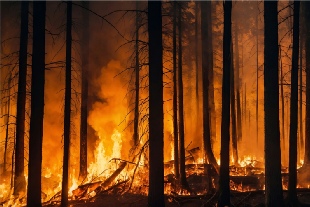
Summer is the season of glorious weather and holidays, of BBQs and trips to the beach—and now, it seems, of insatiable wildfires that consume areas the size of small countries. So far this year in Europe, fires have burned roughly 530,000 hectares (1.3 million acres), putting it on track to equal last year’s record of 1 million hectares (2.5 million acres)—a region slightly bigger than Cyprus. That figure rises to over 2.5 million hectares (6.2 million acres) in the US this summer and around 4 million hectares (9.9 million acres) in Canada. When smoke from the largest Canadian fires drifted into the US last month, Donald Trump helpfully told Canadian Prime Minister Mark Carney (in person, at the World Cup final in New Jersey) that he had to stop “poisoning our air.” Wildfires are also politically divisive in Europe—but there, a new strategy is urging countries to put their differences aside to combat these lethal fixtures of the summer season, which have so far cost the continent an estimated $19 billion in damages. Most wildfires are not purely natural phenomena. Only a small proportion are caused by lightning, although such fires account for a higher ratio of land burned, as they usually occur in remote areas. According to the European Environment Agency, 95% of European wildfires are caused by humans, whether deliberately or by accident, while the US National Park Service puts that figure at nearly 90%. The scientific consensus, however, is that global warming is making wildfires worse than they used to be. In an increasingly common cycle known as “weather whiplash,” wetter winters and springs create an abundance of greenery on forest floors, which rapidly dries out during summer heatwaves. The result is a huge amount of fuel for wildfires. Researchers at the University of Maryland estimate that forest fires now burn twice as much tree cover as they did in the early 2000s. The process is cyclical: according to EU statistics, this year’s fires have already released almost 18 million metric tons of CO2 into the atmosphere. Wildfires both feed off and contribute to global warming, in a destructive cycle that’s consuming more land every year. The consistency and ferocity of wildfire seasons suggest that prevention needs to
be prioritized, alongside the strengthening of countries’ capacity to fight blazes
once they’re burning. It’s encouraging, then, that the EU Commission’s 2026 wildfire
policy does exactly that, at least on paper. Anna- As well as augmenting its rescEU firefighting fleet with 12 new planes and 5 helicopters,
the EU is focused on building “fire- In Spain, 223,000 hectares (551,000 acres) have burned so far this summer, 135% above
the 20- The composition of the landscape also contributed to the scale of the Spanish fires. A 2017 EU report noted that, during and after the dictatorship of Francisco Franco, which lasted from 1939 to 1975, 3 million hectares (7.4 million acres) of former farmland across the country were converted into pine and eucalyptus forests. Both species are highly profitable, as they’re able to grow fast in poor soils and provide a range of industrial uses, from paper and cardboard to timber and utility poles. They are also extremely flammable: the fallen needles of pine trees, especially, make excellent fuel. Almería, by contrast, is home to Europe’s only desert; its barren scrub and esparto grass also provide ideal tinder for wildfires. Natural disasters in Spain usually highlight tensions between the country’s regional administrations, which have initial responsibility for managing emergencies, and the central government, currently led by Socialist Pedro Sánchez, which can intervene at their request. Eleven of Spain’s 17 autonomous regions are ruled by the conservative Popular Party (PP), so these disputes quickly turn ideological, with the familiar taunts of climate denial or fanaticism blended in with accusations of blame. Spanish politicians can’t resist these kinds of disputes, even when things go relatively well. In October 2024, the then- Ayuso acted quickly and effectively, but was still slammed. “We all know,” sniped
transport minister Oscar Puente on X, “that the UME has become the new firefighting
service for the autonomous communities governed by the PP”—as if the national emergency
response unit were sent in to save political reputations rather than lives. Spain’s
center- Unlike its Iberian neighbor, Portugal has been relatively unaffected by wildfires
this year: so far, just over 50,000 hectares (123,500 acres) have burned, 52% below
the 20- France has also seen historic blazes this summer. An inferno in Gironde near Bordeaux burned around 42,000 hectares |
|
|
(104,000 acres) in late July, making it the largest wildfire in France since World
War II. It created a pyrocumulonimbus, a fire- The Gironde fire is already prompting calls for a reformulation of land management
in southwestern France. The affected area is home to the Landes de Gascogne, Western
Europe’s largest manmade woodland, over two- A general election is due in France next year—but perhaps surprisingly, the Gironde
blaze hasn’t been heavily politicized. A recent poll put the center- Greece is another of Southern Europe’s most fire- The wildfire that broke out in the Evros region of northeastern Greece in August that year remains the largest in EU history. It reduced an area of 96,000 hectares (237,000 acres) to charred wasteland, including 58% of the protected Dadia Forest National Park. Of the 20 people killed, 18 were illegal immigrants who had crossed the Turkish border in search of EU asylum. But rather than being mourned, they were blamed. Social media messages circulated claiming that migrants were setting fires all over the region, an unfounded allegation that also received the backing of national politicians. This self- Across the Atlantic, Canada has about a quarter of the Earth’s boreal forest and,
like Europe, is heating up at around twice the global average. It has experienced
historically severe wildfire seasons over the last three years, with the worst on
record occurring in 2023, when 15 million hectares (37 million acres) burned—an area
larger than England. These generated 140 pyrocumulonimbi, whereas previous years
had seen just one or two. Ontario and the Northwest Territories have been the worst
affected this year, with 15,000 people evacuated in British Columbia. For a few days
last month, Toronto had the world’s worst air quality, its citizens engulfed in fumes
from fires raging hundreds of kilometers away. A 2024 study found that 1.5 million
deaths per year globally are attributable to fire- Canada’s political dispute over natural disasters, like that in Spain, is focused
on the division between regional and national powers. Canada is the only G7 country
that doesn’t have a centralized emergency unit to deal with wildfires, prompting
Ontario premier Doug Ford to call for a “large national fire agency [because] [w]e
seem to be going through this every summer.” The need for such an organization became
even more urgent after two of Ontario’s indigenous First Nation communities—Namaygoosisagagun
and Whitewater Lake—were destroyed by wildfires in July. Inhabitants of Namaygoosisagagun
safely self- As you’d expect of a leader who believes that climate change is “the greatest con
job ever perpetrated on the world,” Trump has fully exploited these fires’ potential
for political point- As Trump blames Canada for smoke pollution, the US is on course for one of its worst- Announcing the EU’s new wildfire strategy earlier this year, Hadha Lahbib, the bloc’s Commissioner for Equality, Preparedness, and Crisis Management, said, “Wildfires know no borders, and neither should our response.” Collaboration, both between and within nations, will be key to effective wildfire management in the future—not only in fighting live blazes but in preventing their ignition. Perhaps a collaborative approach would also mitigate the political storms that accompany them. |